Surface Coal Mining:
Surface coal mining generally involves the following sequence of unit operations:
(1) clearing the land of trees and vegetation,
(2) removing and storing the top layers of the unconsolidated soil (topsoil),
(3) drilling the hard strata over the coal seam,
(4) fragmenting or blasting the hard strata with explosives,
(5) removing the blasted material, exposing the coal seam, and cleaning the top of the coal seam,
(6) fragmenting the coal seam, as required, by drilling and blasting,
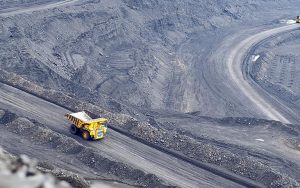
(7) loading the loose coal onto haulage conveyances,
(8) transporting the coal from the mine to the plant, and
(9) reclaiming lands affected by the mining activity.
Methods adopted in Surface Mining:
When the coal seams occur near the surface, it may be economical to extract the coal using open cut
(also referred to as open cast, open pit, mountaintop removal or strip) mining methods. Open cast coal
mining recovers a greater proportion of the coal deposit than underground methods. Large open cast
mines can cover an area of many square kilometers and use very large pieces of equipment.
Surface mining techniques can be broadly classified into the following types:
(1) contour strip mining,
(2) area strip mining,
(3) open-pit mining, and
(4) auger mining.
Contour strip mining:
Contour strip mining is a method of surface mining or in which bulldozers, power shovels, or
stripping wheels are used to remove large chunks of earth in terraced strips in order to extract coal
from a seam or series of seams on a hill or mountain.
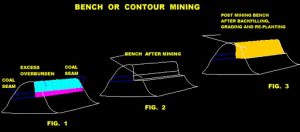
The contour mining method consists of removing overburden from the seam in a pattern following the
contours along a ridge or around the hillside.
The process of contour mining begins with constructing roads to access the coal seam elevation and
the top or the mountain. A bench is excavated in the mountain at the coal seam elevation, allowing for
room for the mining equipment and facilities.
The limitations of this method of mining are both economical and technical .When the burden
undertaken exceeds the coal obtained, the result would be a financial loss. The amount of waste
accumulated after this method of mining is comparatively very high to open pit mining.
Area strip mining :
Strip mining exposes coal by removing earth above each coal seam. This earth is referred to as
overburden and is removed in long strips. The overburden from the first strip is deposited in an area
outside the planned mining area and referred to as out-of-pit dumping. Overburden from subsequent
strips are deposited in the void left from mining the coal and overburden from the previous strip.
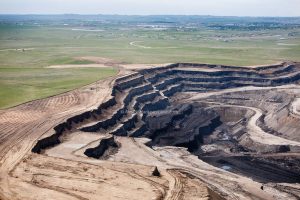
This is referred to as in-pit dumping.
“Strip mining” is the practice of mining a seam of mineral, by first removing a longstrip of
overlying soil and rock (the overburden). It is most commonly used to mine coal and lignite
(brown coal).
Area strip mining, applied where the terrain is flat, commences with a trench or “box cut” made
through the overburden to expose a portion of the coal seam.
This trench is extended to the limits of the property in the strike direction.
After coal removal, a second cut is made parallel to the first one, and the overburden material from
this cut is placed in the void of the first cut. The process is repeated in successive parallel cuts until
the stripping ratio indicates that continued surface mining is uneconomical.
Open-pit mining:
This type of mining involves the extraction of rock or minerals from the earth by forming an open pit.
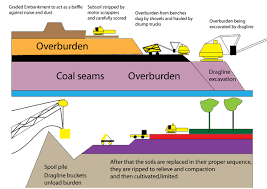
This process differs from the other method which requires digging into the earth. This method of
mining is carried out where useful minerals or rocks are found near the surface.
The open-pit method
is generally practiced where thick coal seams are overlain by thick or thin overburden; it is also used
for mining steeply pitching coal seams.
In open-pit mining of the coal seam, several benches are established in both the overburden strata and
the coal seam. In the beginning stages of mining, considerable volumes of overburden materials must
be accumulated in large dump areas outside the mine
Auger mining:
Auger mining is a relatively low cost method of coal mining and is practical in areas where the
overburden (material covering the coal seam) is too thick to be removed economically or where the
coal seam is too thin for underground mining.
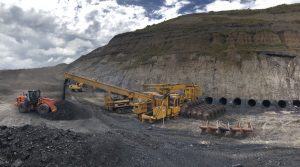
Auger mining is a surface mining technique used to recover additional coal from a seam located
behind a highwall produced either by stripping or open-pit mining.
Auger mining uses large-diameter drills mounted on mobile equipment to bore into a coal seam.
Holes are horizontally drilled at regular intervals to depths of as much as 1,000 feet. As the cutting
head of the auger bites into the coalface, the cut coal is carried out by the screw portion of the bit.
Once the hole is mined to its required depth, the auger machine is moved a few feet and another hole
is drilled.
Auger mining can create pits up to 500 feet into the highwall depending on the conditions of the site
and the type of auger used. This mining method is generally inexpensive; however, coal recovery
rates are low. Auger mining is usually associated with contour strip mining.
Coal recovery rates approach 60 percent with this method. The cutting heads of some augers are as
high as 2.5 metres. As each stem works its way into the coal seam, additional auger stems are added,
so that hole depths of more than 60 to 100 metres are not uncommon. Problems of subsidence, water
pollution, and potential fires are associated with augering.
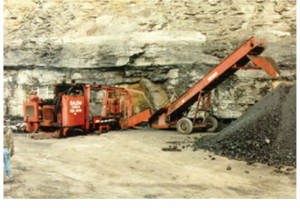
Highwall mining is an adaptation of auger mining.
Instead of an auger hole, an entry into the coal seam is made by a continuous miner, remotely
operated from a cabin at the surface.
The cut coal is transported by conveyors behind the miner to the outside. Using a television camera,
the operator can see and control the miner’s progress.
The entry can be advanced 300 to 400 metres into the coal seam, after which the miner is retreated to
the surface and repositioned to drive an entry adjacent to the previous one.
Advantages over augering include higher productivity, greater safety, and lower cost.